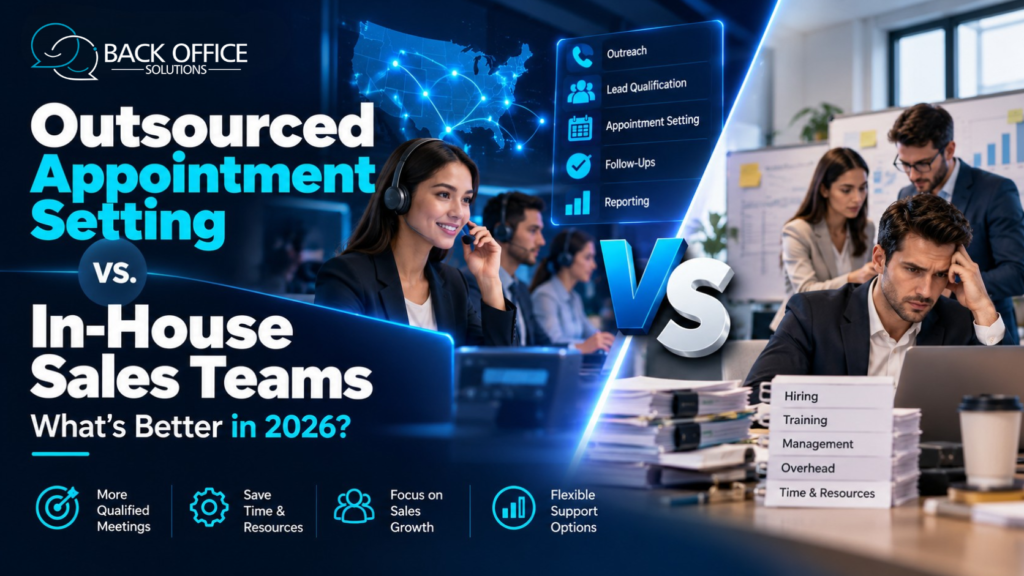
Growing a business requires more than generating leads. You also need a reliable process for contacting potential customers, qualifying their interest, scheduling meetings, and keeping your sales pipeline organized.
For many U.S. small businesses, this creates an important question: Should you use outsourced appointment setting services or build an in-house sales team?
Both approaches can help businesses connect with prospective customers, but they differ in cost structure, management responsibilities, flexibility, and control.
Outsourcing may provide additional capacity for prospecting and scheduling, while an in-house team may offer closer collaboration and deeper familiarity with your products.
In this guide, we’ll compare outsourced appointment setting vs. in-house sales teams, explain their advantages and limitations, and help you determine which approach fits your business in 2026.
What Is Outsourced Appointment Setting?
Outsourced appointment setting involves hiring an external provider to help identify suitable prospects, coordinate approved outreach, qualify interest, and schedule sales conversations.
Depending on the service agreement, an appointment-setting provider may handle:
- Prospect research and lead list management
- Outreach coordination
- Initial lead qualification
- CRM updates and contact records
- Appointment scheduling and confirmations
- Meeting reminders
- Follow-up administration
- Sales activity reporting
For example, a digital marketing agency might use outsourced appointment setting to arrange introductory calls with businesses interested in website development or SEO services.
The agency’s internal team can then focus on consultations, proposals, and closing opportunities.
Appointment setting is only one part of the sales process. It does not automatically replace account executives, sales managers, or other employees responsible for managing complex deals.
What Is an In-House Sales Team?
An in-house sales team consists of employees who work directly for your business.
Depending on your company’s structure, these employees may be responsible for prospecting, qualifying leads, scheduling meetings, presenting solutions, negotiating contracts, and managing customer relationships.
For small businesses, an internal sales function may include:
- Sales development representatives (SDRs)
- Business development representatives (BDRs)
- Account executives
- Sales managers
- Administrative sales support
One advantage of internal staffing is that employees may develop a detailed understanding of your company’s products, services, customers, and long-term sales strategy.
However, building an in-house team also requires recruiting, onboarding, training, management, tools, and ongoing performance evaluation.
Outsourced Appointment Setting vs. In-House Sales: Key Differences
The right approach depends on what your company needs from its sales operations.
| Factor | Outsourced Appointment Setting | In-House Sales Team |
|---|---|---|
| Hiring | External provider supplies agreed support | Company recruits employees |
| Cost structure | Contract, hourly, retainer, or other agreed pricing | Compensation, benefits, tools, and overhead |
| Management | Requires coordination and provider oversight | Direct day-to-day management |
| Flexibility | Depends on contract and provider capacity | Depends on staffing and hiring |
| Product knowledge | Developed through onboarding | Developed through internal training |
| Lead qualification | Based on agreed criteria | Based on internal sales processes |
| Sales closing | Usually retained by the client unless specifically included | Can be handled internally |
| Data access | Requires controlled external access | Managed through internal permissions |
Neither model guarantees more meetings, better leads, or increased revenue.
Success depends on prospect targeting, communication quality, sales processes, compliance, and consistent follow-up.
5 Benefits of Outsourcing Appointment Setting
1. Reduce the Administrative Burden on Your Sales Team
Sales representatives often spend time researching prospects, updating CRM records, coordinating calendars, and following up on meeting requests.
These responsibilities are important, but they can reduce the time available for activities such as client consultations and proposal development.
Outsourcing selected appointment-setting tasks can help distribute that workload more effectively.
For example, an external team might manage meeting confirmations while internal sales representatives concentrate on preparing for scheduled consultations.
2. Access Additional Prospecting Support
Small businesses may not have enough internal capacity to maintain consistent prospecting activities.
An external appointment-setting team can provide additional support for agreed outreach and scheduling responsibilities.
Before selecting a provider, assess its relevant experience, communication capabilities, training procedures, and approach to lead qualification.
3. Adjust Support as Business Needs Change
Some businesses experience seasonal changes in demand.
Others need temporary support while testing a new market or service offering.
Depending on contract terms, outsourcing may allow businesses to adjust their appointment-setting arrangements without immediately expanding their permanent internal workforce.
However, service availability and flexibility should be confirmed before signing an agreement.
4. Maintain More Organized Follow-Ups
Potential customers may require additional information or scheduling assistance before agreeing to a meeting.
A structured appointment-setting process can help maintain accurate records, organize follow-ups, and prevent interested prospects from being overlooked.
Clear CRM procedures are essential.
Every interaction should have an appropriate status, assigned responsibility, and next action.
5. Allow Sales Representatives to Focus on Qualified Conversations
Sales representatives may create more value when they spend time speaking with relevant prospects rather than coordinating every administrative detail.
Outsourced support can help with the activities leading up to a meeting, provided qualification criteria and handoff procedures are clearly defined.
The objective should be arranging suitable conversations, not simply increasing the number of calendar bookings.
When Is an In-House Sales Team a Better Choice?
Outsourcing is not the right solution for every business.
An internal team may be more appropriate when sales activities require extensive technical knowledge, close coordination with company leadership, or frequent involvement in complex negotiations.
Businesses Selling Complex Solutions
Companies offering specialized software, engineering services, or highly customized solutions may need sales professionals with detailed technical expertise.
These responsibilities can be difficult to delegate without significant training.
Businesses Requiring Close Internal Collaboration
Some sales teams work directly with product development, finance, legal, and customer success departments.
Internal staffing may make coordination easier when complex decisions require continuous collaboration.
Businesses Building Long-Term Strategic Relationships
When a company’s revenue depends heavily on a small number of major accounts, relationship management may be most effective when led by experienced internal sales professionals.
Even in these situations, companies can still outsource selected research, CRM administration, and scheduling tasks.
How Much Does Outsourced Appointment Setting Cost?
Appointment-setting costs vary according to service scope, industry, outreach channels, staffing requirements, and provider experience.
Common pricing structures include:
Hourly arrangements: Businesses pay for agreed working time. This can make sense when the workload is predictable.
Monthly retainers: Providers charge a recurring amount for a defined level of support or services.
Dedicated staffing: A business works with an assigned professional or team under agreed availability and responsibility arrangements.
Performance-related pricing: Some providers charge based on defined outcomes, such as qualified appointments. These arrangements require especially clear definitions and verification procedures.
An in-house team may involve salaries, employment-related expenses, recruitment, training, management time, software, and office or remote-work support.
When comparing options, calculate the complete cost of your sales development process rather than looking only at the initial quoted price.
A Practical Cost Comparison
Imagine two options for the same small business.
Option A involves hiring a dedicated internal sales development representative.
Option B involves outsourcing defined prospecting and scheduling responsibilities while retaining internal salespeople for consultations and closing.
The company should compare:
- Total monthly operating costs
- Training and management time
- Number of qualified meetings attended
- Sales opportunities created
- Quality of prospect information
- Customer acquisition outcomes
The more economical arrangement is the one that produces suitable business outcomes at an acceptable total cost—not necessarily the option with the lowest monthly fee.
Why Lead Quality Matters More Than Appointment Quantity
A calendar filled with meetings doesn’t automatically mean a healthy sales pipeline.
Suppose one approach generates many appointments with companies that lack the budget or need for your services.
Another approach produces fewer meetings with businesses that match your ideal customer profile.
The second approach may create more meaningful sales opportunities.
Before working with an appointment-setting team, define what qualifies as a suitable meeting.
Your qualification criteria might include:
- Target industry
- Business size
- Geographic market
- Relevant service needs
- Decision-maker involvement
- Budget considerations
- Appropriate buying timeframe
The criteria should reflect your actual sales process.
A good provider should understand that successful appointment setting is about relevance, not inflated booking counts.
Can Outsourced Appointment Setting and In-House Sales Work Together?
Yes. A hybrid model may be an effective choice for businesses that want to retain control of important sales conversations while delegating suitable supporting activities.
In this arrangement, an external team manages agreed prospecting and scheduling tasks, while internal sales employees handle consultations, proposals, negotiations, and relationship management.
Example: A U.S. Web Development Agency
Imagine a growing web development agency serving small businesses in the United States.
The agency’s founders are responsible for project consultations, proposals, and client delivery.
As the business grows, they find it difficult to maintain consistent prospecting and follow-up activities.
The agency decides to test an outsourced appointment-setting arrangement.
Step 1: Define Target Customers
The agency identifies the industries, company sizes, and types of website projects it wants to pursue.
Step 2: Establish Approved Outreach Processes
The external support team receives documented prospecting criteria, appropriate communication guidelines, and approved workflows.
Step 3: Maintain CRM Information
Lead records are organized and updated according to the company’s data-handling procedures.
Step 4: Coordinate Interested Prospects
When a suitable prospect expresses interest, the support team helps arrange an introductory consultation.
Step 5: Transfer the Conversation
An internal representative conducts the consultation, evaluates project requirements, and prepares a proposal when appropriate.
Step 6: Evaluate Performance
The agency reviews meeting attendance, prospect quality, sales opportunities, and the total cost of the arrangement.
This hypothetical example demonstrates how a hybrid workflow could operate. Actual results depend on the business, provider, and implementation.
What About AI Appointment Setting?
AI-powered tools can support selected scheduling and administrative activities.
For example, approved automation may help with calendar availability, reminders, CRM data organization, or routine message preparation.
However, businesses should carefully evaluate how these systems handle personal information, changing requirements, incorrect responses, and customer preferences.
Automated calling or messaging can also raise additional legal and consent considerations.
A practical approach is to use automation where appropriate while maintaining human oversight for sensitive, complex, or unusual situations.
7 Things to Check Before Hiring an Appointment-Setting Provider
1. Relevant Industry Experience
Ask whether the provider understands the types of businesses and decision-makers you want to reach.
2. Lead Qualification Process
Clarify how prospects are evaluated and what qualifies as a completed appointment.
3. Communication Quality
Review how the team represents your brand and responds to prospect questions.
4. CRM Compatibility
Confirm which tools the provider can use and how lead records will be managed.
5. U.S. Market Coverage
If you serve American businesses, establish expectations regarding U.S. time zones, meeting availability, and communication practices.
6. Legal Compliance and Data Security
Outreach activities must comply with applicable requirements.
Depending on the channels and recipients involved, U.S. businesses may need to consider the CAN-SPAM Act, telephone solicitation requirements, the Telephone Consumer Protection Act, relevant FTC rules, state regulations, and applicable privacy obligations.
Rules vary by activity. Businesses should obtain appropriate legal guidance rather than assuming all B2B outreach is exempt.
7. Reporting and Accountability
Agree on the measurements you’ll review and how frequently performance will be evaluated.
Look for transparent information about completed activities, meeting outcomes, qualification quality, and unresolved issues.
How to Measure Appointment-Setting Performance
Businesses should evaluate appointment setting using meaningful sales indicators.
Qualified appointments: Meetings that satisfy agreed qualification criteria.
Attendance rate: The percentage of scheduled meetings actually attended.
Opportunity conversion rate: The proportion of meetings that progress into suitable sales opportunities.
Cost per qualified appointment: Total relevant program cost divided by qualified appointments generated.
Sales conversion: The proportion of opportunities that eventually become customers.
CRM data quality: Whether contact information, notes, and activity records remain accurate.
Review these indicators together.
For example, a high booking rate may be less useful if prospects regularly miss meetings or do not match your target audience.
Frequently Asked Questions
Is outsourced appointment setting better than in-house sales?
Not necessarily. Outsourcing may suit businesses that need additional prospecting and scheduling support. In-house staffing may be more appropriate for complex sales, close team coordination, and strategic relationship management. A hybrid arrangement can also work.
Is outsourced appointment setting suitable for small businesses?
Yes, it can be suitable when a business has a clearly defined target market, established service offerings, and a reliable process for handling interested prospects. Results depend on the quality of the arrangement and sales process.
Does outsourced appointment setting include closing sales?
Usually, appointment setting focuses on identifying suitable prospects and scheduling conversations. Sales closing is a separate responsibility unless it is specifically included in the service agreement.
Can an outsourced team use our CRM?
Some providers can work with existing CRM systems, subject to compatibility, permissions, security requirements, and agreed workflows. Confirm specific platform capabilities before hiring.
How long does it take to see results?
The timeframe varies according to the industry, quality of prospect data, outreach methods, sales cycle, onboarding, and qualification criteria. Businesses should set realistic evaluation periods and monitor performance without expecting guaranteed appointments.
What is the difference between lead generation and appointment setting?
Lead generation involves attracting and identifying prospective customers. Appointment setting focuses on qualifying suitable interest and coordinating sales meetings. The two activities are connected but have different responsibilities.
Final Thoughts: Choose the Model That Fits Your Business
The decision between outsourced appointment setting and an in-house sales team depends on your company’s goals, resources, target customers, and sales process.
Outsourcing can provide support for prospecting, scheduling, and sales administration.
An internal team can offer closer collaboration, detailed product knowledge, and direct management of important customer relationships.
For many businesses, combining both approaches may be worth considering.
Whatever model you choose, focus on qualified conversations, clear processes, responsible outreach, accurate CRM information, and measurable business outcomes.
The objective isn’t simply to book more meetings.
It’s to create a sales process that helps your business connect with the right potential customers.
Get Appointment Setting and Sales Support From Back Office Solutions
Consistent prospecting, appointment coordination, and CRM management can take considerable time away from running a business.
Back Office Solutions offers appointment setting, lead generation, CRM management, and virtual assistant services to support business operations.
Whether your company needs dedicated assistance with selected sales activities or ongoing administrative support, our team can discuss your business requirements.
Explore Back Office Solutions and contact us to discuss your appointment-setting and sales support needs.