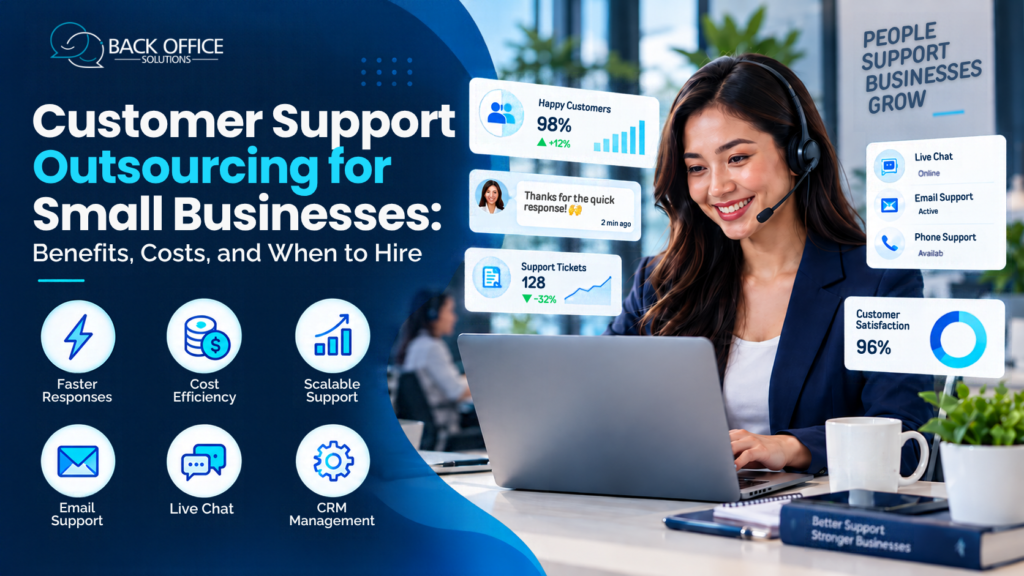
Customer expectations don’t stop when a small business gets busy. Whether someone needs an order update, help with a service, or an answer before making a purchase, timely customer communication can influence their experience with your company.
For growing businesses, managing those conversations alongside everyday operations can become challenging.
That’s where customer support outsourcing can help.
Instead of handling every customer inquiry internally, businesses can work with an external support provider to manage selected communication tasks through agreed channels and processes.
But is outsourcing customer service the right decision for every small business?
In this guide, we’ll explore how customer support outsourcing works, its potential benefits, common costs, important challenges, and the signs that your company may be ready for additional support.
What Is Customer Support Outsourcing?
Customer support outsourcing is the practice of hiring an external company or team to handle some or all customer service responsibilities.
These responsibilities may include answering questions, addressing common issues, processing routine requests, managing support tickets, or communicating with customers through email, phone, chat, and other approved channels.
The exact services depend on the provider and your agreement.
For example, a growing ecommerce company might outsource routine shipping questions and return requests while keeping complex complaints and refunds requiring special approval with its internal management team.
The goal isn’t simply to move work outside your company.
It’s to create a reliable support process that maintains customer service quality while allowing your internal team to focus on other responsibilities.
How Does Customer Service Outsourcing Work?
Outsourcing customer support typically involves a structured onboarding process.
Step 1: Identify Your Support Requirements
Start by reviewing the types of customer questions your business receives.
Are customers frequently asking about deliveries, appointment availability, billing, product information, or service updates?
Understanding your inquiry volume, channels, and common problems will help you determine which activities can be delegated.
Step 2: Choose the Right Support Model
Different businesses require different arrangements.
Some need email support for several hours each weekday. Others need additional support during busy periods or coverage outside their normal operating hours.
An outsourcing provider may offer dedicated, shared, part-time, or other staffing arrangements, depending on its capabilities.
Step 3: Establish Processes and Training
The external team needs accurate information about your products, services, policies, and customer communication standards.
This may include training materials, response templates, escalation procedures, and access to approved systems.
Step 4: Set Communication and Performance Expectations
Define what successful support looks like.
For example, you may set response-time targets, quality standards, escalation requirements, and reporting procedures.
Step 5: Review Performance Regularly
Outsourcing requires ongoing oversight.
Businesses should review customer feedback, support quality, unresolved issues, and operational metrics to identify opportunities for improvement.
7 Benefits of Customer Support Outsourcing for Small Businesses
1. More Time to Focus on Business Growth
Small business owners often manage sales, marketing, operations, and customer inquiries themselves.
As the business grows, handling every support request can reduce the time available for planning and strategic activities.
Outsourcing suitable customer support tasks can help distribute the workload more effectively.
For example, an owner who regularly spends time responding to appointment inquiries could delegate routine scheduling communication and focus more on serving customers or developing new business opportunities.
2. Greater Flexibility During Busy Periods
Customer inquiry volumes aren’t always predictable.
Ecommerce businesses may experience seasonal shopping peaks, while service providers may see increased inquiries during promotions or specific times of the year.
An external support arrangement can provide an additional staffing option when demand increases, subject to the provider’s available capacity and agreement.
This may be useful for businesses that aren’t ready to expand their permanent internal team.
3. Access to Support Specialists
Some customer support providers have experience with ticketing systems, communication tools, customer service procedures, and industry-specific workflows.
Working with appropriately trained specialists can help a business implement more organized support operations.
However, expertise varies between providers.
Before hiring, review the team’s training, communication skills, relevant experience, and quality-control processes.
4. Better Organization of Customer Requests
When customer messages arrive through multiple channels, important inquiries can become difficult to track.
A structured support process can help organize requests, assign responsibilities, document conversations, and identify unresolved issues.
For example, using an agreed ticketing workflow can make it easier to determine which inquiries need follow-up and which cases require management approval.
5. Potential Cost Flexibility
Hiring in-house employees can involve recruitment, compensation, training, management, tools, and related operational expenses.
Outsourced customer service may offer an alternative pricing structure that better matches certain workloads.
However, outsourcing is not automatically cheaper.
Total cost depends on staffing requirements, service complexity, coverage hours, training, management, and the provider’s pricing model.
The right comparison is between the full cost and value of each arrangement.
6. More Consistent Customer Communication
Customers benefit when they know how to contact a business and what to expect from its support process.
Clear response procedures, approved communication guidelines, and defined escalation rules can support a more consistent experience.
An external team can help follow those procedures when it is properly trained and supervised.
7. Support Across Multiple Communication Channels
Depending on the provider, outsourced customer support may include email, live chat, telephone communication, CRM updates, or help desk ticket management.
This gives businesses the option to organize customer interactions across the channels their customers use.
The important thing is to select channels that your customers actually need, rather than offering additional channels without the ability to manage them effectively.
Customer Support Outsourcing vs. In-House Customer Service
Both approaches have advantages and limitations.
| Factor | Outsourced Customer Support | In-House Customer Support |
|---|---|---|
| Staffing | External team under a service arrangement | Employees hired and managed internally |
| Flexibility | Depends on provider capacity and contract | Depends on available employees |
| Training | Requires provider onboarding and brand knowledge | Requires internal recruitment and training |
| Management | Shared responsibilities and oversight | More direct day-to-day supervision |
| Costs | Contract, usage, staffing, and management expenses | Compensation, recruitment, tools, and overhead |
| Customer knowledge | Must be developed through onboarding | May develop through closer internal involvement |
| Quality control | Requires agreed reporting and review procedures | Managed through internal processes |
Neither arrangement is universally better.
For businesses handling sensitive cases or highly specialized product issues, retaining certain support activities internally may be appropriate.
Other businesses may benefit from outsourcing routine inquiries while keeping management-level decisions in-house.
How Much Does Customer Support Outsourcing Cost?
The cost of outsourced customer support varies considerably.
Instead of relying on a single average price, businesses should understand the different pricing models available.
Hourly Pricing
Some providers charge based on the number of hours worked.
This arrangement can be suitable when staffing needs are relatively predictable.
Dedicated Support Pricing
A business may pay for an assigned support professional or team under an agreed staffing arrangement.
This may be appropriate when consistent availability and familiarity with the company’s operations are priorities.
Per-Ticket or Usage-Based Pricing
Certain providers offer pricing based on support activity, such as tickets or interactions handled.
Businesses should review how billable interactions are defined and whether unusual or complex requests are treated differently.
Monthly Service Packages
Some outsourcing arrangements use recurring packages with defined services, coverage, and limitations.
When comparing quotations, ask about:
- Training and onboarding fees
- Minimum contract commitments
- Supported communication channels
- Reporting and quality monitoring
- Software and integration costs
- Additional coverage or overtime
- Escalation and management responsibilities
A lower quoted price may not represent better value if important services are excluded.
6 Signs Your Small Business May Need Outsourced Customer Support
1. Customer Messages Frequently Go Unanswered
If inquiries remain unattended because your internal team is overloaded, additional support may be worth considering.
Review the reasons for delays before choosing a solution.
2. Your Employees Are Managing Too Many Responsibilities
When the same people handle sales, operations, administration, and customer service, competing priorities can affect productivity.
Delegating routine support work may allow employees to focus on their primary responsibilities.
3. Customer Inquiries Are Increasing
Growth often creates additional communication needs.
If your existing team is struggling to manage growing inquiry volumes, consider whether an external support arrangement would provide useful capacity.
4. Your Business Needs Different Coverage Hours
Some companies serve customers across multiple U.S. time zones.
If customers frequently contact your business outside its current support schedule, you may need additional coverage.
Confirm the provider’s actual working hours and availability before making commitments to customers.
5. You Need More Organized Follow-Ups
A business may lose track of inquiries when communication takes place across different inboxes, spreadsheets, or tools.
A trained support team using an approved workflow can help maintain records and follow-up procedures.
6. Customer Service Is Taking Time Away From Core Operations
If customer support consistently prevents your team from completing important business activities, it may be time to reassess how responsibilities are assigned.
Outsourcing is one possible solution alongside process improvement, internal hiring, and appropriate automation.
Practical Example: Customer Support Outsourcing for an Online Store
Imagine a small U.S. ecommerce business selling home accessories.
During a promotional period, the company begins receiving more customer messages than its internal team can comfortably manage.
The most common requests involve shipping updates, product availability, returns, and order information.
The business decides to test an outsourced support arrangement.
The external team receives approved product information, customer communication guidelines, and clearly defined procedures.
Routine shipping inquiries are handled using verified order information. Return requests follow the company’s documented policy.
Cases involving unusual complaints, disputed charges, or exceptions are escalated to an authorized employee.
The company reviews support performance during the trial period before deciding whether to expand the arrangement.
This hypothetical example illustrates how outsourcing can work. Actual outcomes depend on implementation, customer needs, and provider performance.
Common Challenges of Outsourcing Customer Support
Customer service outsourcing also creates responsibilities that businesses shouldn’t overlook.
Maintaining Brand Voice
An external team must understand how your company communicates.
Provide clear examples, preferred language, policies, and guidelines for handling sensitive situations.
Protecting Customer Data
Support teams may require access to personal information, order records, or account details.
Businesses should assess appropriate data security controls, access permissions, confidentiality obligations, and applicable legal requirements.
Avoid granting broader system access than necessary.
Handling Complex Customer Issues
Not every problem should be resolved by a frontline support representative.
Create escalation rules for complaints, unusual requests, refunds, account security issues, and other sensitive matters.
Monitoring Service Quality
Regularly review sample interactions, customer feedback, training needs, and unresolved issues.
Outsourcing should not mean giving up accountability for the customer experience.
How AI and Human Support Teams Can Work Together
AI-powered customer service tools can assist with tasks such as categorizing tickets, drafting responses, and answering common questions using approved information.
Human agents remain important for reviewing complex requests, handling exceptions, managing customer relationships, and making authorized decisions.
For example, a chatbot might answer a standard question about business hours.
If a customer reports a complicated billing problem, the system can direct the inquiry to a human support professional.
A hybrid model can be useful when businesses establish clear limits on automation and maintain appropriate oversight.
The goal should be reliable customer support, not automation for its own sake.
How to Choose a Customer Support Outsourcing Provider
Before selecting a provider, ask questions about its capabilities and working practices.
Industry experience: Has the team handled customer inquiries similar to yours?
Communication channels: Does the provider offer the phone, email, chat, or other channels you need?
Working hours: Can its staffing arrangements support your customers’ preferred hours and U.S. time zones?
Data protection: What security and access-management procedures are in place?
Onboarding: How will the team learn your products, policies, and communication style?
Quality assurance: How are interactions monitored, errors addressed, and improvements implemented?
Pricing: What services are included, and which activities may result in additional charges?
Escalation: What happens when a customer has an issue the external team cannot resolve?
A clear written agreement and well-defined responsibilities can help both parties work more effectively.
Measuring the Success of Outsourced Customer Support
Customer support performance should be evaluated using metrics relevant to your business.
Common measurements include:
First response time: How long customers wait before receiving an initial response.
Resolution time: How long it takes to resolve support issues.
Customer satisfaction: Feedback collected through appropriate surveys or other measures.
First contact resolution: The proportion of eligible issues resolved during the first interaction.
Escalation rate: How frequently cases require additional assistance.
Support quality: Whether interactions follow company policies and meet agreed standards.
No single metric tells the whole story.
For example, faster replies may not improve the customer experience if responses are inaccurate or problems remain unresolved.
Use performance measurements together with quality reviews and customer feedback.
Frequently Asked Questions
Is customer support outsourcing suitable for small businesses?
It can be. Small businesses may outsource routine communication or selected support responsibilities when internal staffing, availability, or workload makes additional assistance useful. Suitability depends on service complexity, customer expectations, and available resources.
What customer service tasks can be outsourced?
Depending on the provider, common tasks include answering general inquiries, handling support tickets, coordinating appointments, responding to routine order questions, updating CRM records, and following approved follow-up procedures.
Is outsourced customer support cheaper than hiring employees?
Not always. Outsourcing can offer different staffing and cost arrangements, but total expense depends on the service scope, contract terms, tools, training, and management requirements. Compare the complete costs and expected business value.
Can outsourced customer support work with my existing CRM?
Some providers can work with established CRM platforms and ticketing systems. Compatibility depends on the tools involved, provider capabilities, security requirements, and agreed integrations.
Will outsourcing customer support affect customer experience?
It can affect the customer experience positively or negatively depending on training, communication standards, response quality, oversight, and the processes used. Businesses should monitor performance and maintain clear escalation procedures.
How do I know when to outsource customer service?
Look for recurring support delays, growing inquiry volumes, excessive internal workloads, coverage gaps, or difficulties maintaining organized communication. Assess your processes and compare available support models before making a decision.
Final Thoughts: Build a Customer Support Process That Grows With Your Business
Customer support outsourcing can provide a practical way for small businesses to manage communication demands without requiring every task to remain in-house.
However, successful outsourcing involves more than selecting a provider.
Businesses need clear responsibilities, appropriate training, secure systems, realistic service expectations, and ongoing quality monitoring.
Whether you choose an external support team, develop your internal capabilities, or combine people with carefully managed automation, the priority should remain the same: helping customers receive accurate, timely, and dependable assistance.
Need Help Managing Customer Support?
As your company grows, handling customer inquiries alongside everyday business operations can become increasingly demanding.
Back Office Solutions offers customer support and other specialized back-office services designed to help businesses manage their operational workloads.
Whether you need assistance with customer communication or want to explore how selected responsibilities could be delegated, our team can discuss your requirements.
Visit Back Office Solutions to learn more and contact our team about your customer support needs.