Your business is making sales. Money is coming in. Bills are getting paid.
But do you know what it really costs to manage your books?
Many small business owners compare an employee’s salary with the monthly fee of a bookkeeping service.
That sounds simple. But the true cost involves much more.
Hiring, training, software, missed work, and daily oversight can all affect your budget.
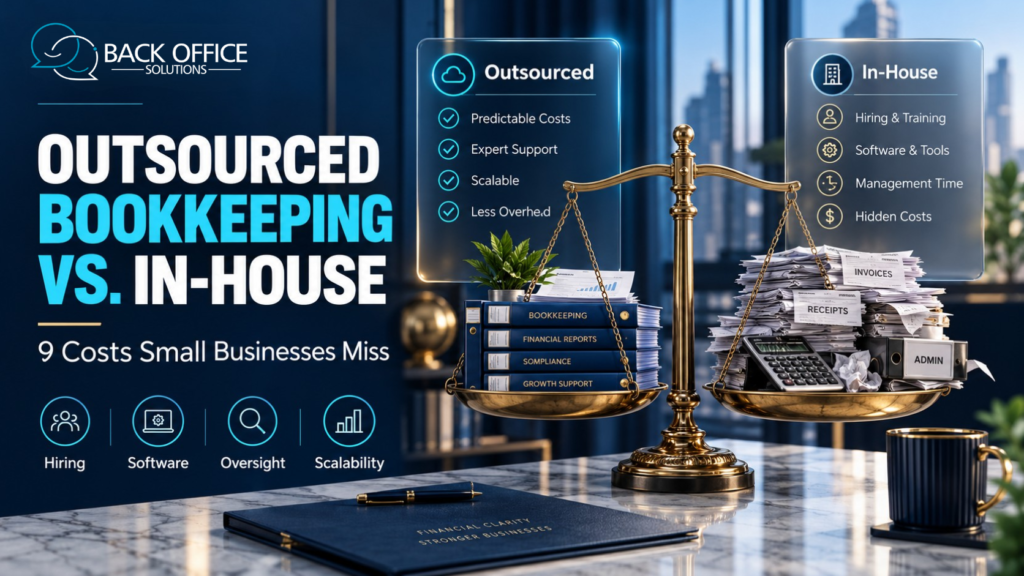
That’s why the choice between outsourced bookkeeping vs. in-house bookkeeping deserves a closer look.
Both options can help you track financial records. But each comes with its own costs and responsibilities.
In this guide, you’ll discover nine costs that small businesses often overlook. You’ll also learn when outsourcing makes sense and when an in-house bookkeeper may be the better choice.
What Is Outsourced Bookkeeping?
Outsourced bookkeeping means hiring an external professional or company to manage agreed bookkeeping tasks.
Instead of hiring someone directly, you pay a provider for the work covered by your service plan.
Depending on the agreement, outsourced bookkeeping services may include:
- Recording business transactions
- Organizing financial records
- Reconciling bank accounts
- Tracking invoices and payments
- Managing accounts payable and receivable
- Preparing routine financial reports
- Keeping bookkeeping records up to date
For example, a small marketing agency may hire a bookkeeping provider to organize expenses and review monthly transactions.
The agency owner can then spend more time managing clients and growing the business.
Outsourcing does not remove the owner’s responsibility for financial oversight. It also doesn’t automatically include tax filing, financial audits, or professional accounting advice.
What Is In-House Bookkeeping?
In-house bookkeeping means managing financial records through an employee or internal team.
A business may hire a full-time or part-time bookkeeper.
That person works under the company’s direct management.
An in-house bookkeeper may record transactions, reconcile accounts, manage invoices, and prepare routine reports.
This model gives the business direct control over the person’s daily work.
However, the company must also handle hiring, training, supervision, and other employment needs.
Outsourced Bookkeeping vs. In-House: What’s the Difference?
The main difference is how your business manages the work and pays for it.
| Factor | Outsourced Bookkeeping | In-House Bookkeeping |
|---|---|---|
| Staffing | External service provider | Internal employee |
| Pricing | Based on agreed services and contract | Wages and related employment costs |
| Management | Shared oversight | Direct supervision |
| Flexibility | Depends on provider and plan | Depends on employee availability |
| Software | May be included or billed separately | Usually managed by the company |
| Coverage | Depends on service agreement | Depends on employee schedules |
| Training | Provider-specific onboarding | Company-led training |
| Communication | Agreed reporting and contact process | Direct internal communication |
Neither option is always cheaper or better.
The right choice depends on your workload, budget, financial processes, and management needs.
9 Bookkeeping Costs Small Businesses Often Overlook
1. Hiring and Recruitment Costs
Finding a skilled bookkeeper takes time.
You may need to advertise a role, review applications, interview candidates, and check references.
These activities can create costs before the employee starts working.
If the person leaves, you may need to repeat the process.
Outsourcing may reduce some recruitment work. However, you still need time to compare providers and review service terms.
Cost to check: How much time and money will your business spend finding the right support?
2. Training and Onboarding
A new bookkeeper needs to understand your company.
They must learn how you record expenses, manage invoices, use software, and approve payments.
An in-house employee may need direct training from your team.
An outsourced provider also needs onboarding. The provider must understand your records and work process.
Both options require clear instructions.
Cost to check: Who will train the bookkeeper, and how long will setup take?
3. Bookkeeping Software and Tools
Bookkeeping software can help organize transactions and financial records.
Your business may use tools such as QuickBooks or Xero.
But software can create costs beyond the main subscription.
You may need extra users, integrations, cloud storage, or other tools.
Some outsourced bookkeeping packages include software-related services. Others expect you to maintain your own subscriptions.
Cost to check: What software fees are included, and what will you pay separately?
4. Employee Benefits and Payroll Expenses
An employee’s salary is not always the full cost of employment.
Depending on the employment arrangement and applicable laws, businesses may have additional payroll taxes, benefits, insurance, and administrative expenses.
These costs can affect the true price of an in-house role.
An outsourced provider usually charges based on a contract or service plan.
But outsourced services may also include extra fees for work outside the agreed scope.
Cost to check: Compare total yearly expenses, not just wages against a monthly service fee.
5. Time Spent Managing Bookkeeping Work
Bookkeeping still needs oversight.
Someone must review reports, answer questions, approve certain actions, and make important financial decisions.
An in-house employee may need regular supervision.
An outsourced provider also needs a clear point of contact.
If your processes are unclear, both arrangements can create extra management work.
Cost to check: How much time will the owner or manager spend reviewing the work?
6. Absences and Workload Gaps
What happens when your bookkeeper takes time off?
Invoices still need attention. Transactions continue to enter your accounts.
A small business with one in-house employee may need backup coverage.
An outsourced provider may offer team-based support. But this depends on the contract and staffing model.
Never assume that outsourcing includes unlimited availability.
Cost to check: Who will manage urgent tasks when your usual bookkeeper is unavailable?
7. Errors and Financial Record Cleanup
Bookkeeping errors can create extra work.
Missing transactions, duplicate entries, and incorrect categories may affect your reports.
These problems can happen under either model.
Fixing old records may require time, additional support, or outside review.
Some bookkeeping providers charge separately for catch-up or cleanup work.
Cost to check: How does each option handle errors, corrections, and quality checks?
8. Data Security and Access Control
Your financial records contain sensitive information.
They may include bank details, vendor records, payments, and customer transactions.
Both in-house and outsourced teams need suitable access controls.
For external providers, review confidentiality terms and how they manage access to financial software.
Use role-based permissions when available. Avoid sharing passwords through unsecured messages.
Keep payment approval rights with authorized people.
Cost to check: What tools, controls, and oversight will protect your financial information?
9. Scaling Your Bookkeeping Support
Your bookkeeping needs may change as your business grows.
You might add employees, products, clients, or locations.
An in-house team may need more working hours or additional employees.
An outsourced provider may offer higher service tiers or extra support.
However, growth can increase costs under either model.
Cost to check: What happens to pricing when transaction volume or reporting needs increase?
How to Compare the True Cost of Bookkeeping
Before making a decision, build a simple 12-month cost comparison.
For an in-house bookkeeper, include wages, relevant employment costs, recruitment, training, software, and management time.
For an outsourced provider, include monthly fees, onboarding, software, catch-up work, extra services, and internal review time.
Ask both options to clarify what is included.
Then compare the same tasks and service hours.
This helps you avoid comparing two prices that cover very different levels of work.
A lower monthly price does not always mean better value.
When Should a Small Business Outsource Bookkeeping?
Outsourced bookkeeping may be a good option when your business needs regular financial record support but does not need a full-time employee.
It may also help if your team spends too much time on routine bookkeeping tasks.
For example, an online service business may need monthly bank reconciliation, invoice tracking, and expense records.
The owner might prefer outside support instead of hiring a dedicated employee.
But the provider should offer the right skills, working process, and security controls.
The best outsourcing arrangement matches your actual workload.
When Is In-House Bookkeeping Better?
In-house bookkeeping may make sense when your company has a large volume of daily financial activity.
It can also be useful when the bookkeeper must work closely with several internal teams.
For example, a growing company may need daily coordination between its finance, purchasing, and operations staff.
An internal employee may provide easier access during normal working hours.
The right decision depends on the type of work and the level of daily support required.
Can You Combine In-House and Outsourced Bookkeeping?
Yes. A hybrid model can work for some businesses.
Your internal team might approve expenses and handle payment decisions.
An external bookkeeping provider can then help record transactions, reconcile accounts, or prepare agreed reports.
For example, a U.S. agency might keep financial approvals with its owner.
An outside team could organize invoices and maintain bookkeeping records.
The business can then share those records with its accountant or tax professional when needed.
Clear responsibilities are important.
Make sure everyone knows who records information, who reviews it, and who approves transactions.
A Practical Bookkeeping Example
Imagine a small digital marketing agency in the United States.
The agency has several clients and recurring software expenses.
At first, the owner manages all bookkeeping tasks.
As the business grows, it becomes harder to keep records up to date.
The owner starts comparing two choices.
Option A: Hire a part-time in-house bookkeeper.
Option B: Use an outsourced bookkeeping service for defined monthly tasks.
The owner reviews service fees, training, software costs, and management time.
They also check data security and reporting needs.
The agency chooses the option that best fits its workload and budget.
This is a fictional example. Actual costs and results vary by business.
How to Choose a Bookkeeping Service
Before hiring a provider, ask clear questions.
What tasks are included? Make sure the provider explains the services it will handle.
How often will records be updated? Agree on reporting and reconciliation schedules.
Which software can the team use? Confirm compatibility with your current tools.
How will financial data stay secure? Review access controls and confidentiality practices.
What costs extra? Ask about cleanup work, additional reports, and increased transaction volume.
Who reviews the work? Understand the provider’s quality-control process.
You should also know what happens when an issue needs input from an accountant or tax professional.
Frequently Asked Questions
Is outsourced bookkeeping cheaper than in-house bookkeeping?
It can be, but not always. Costs depend on workload, staffing, software, and service needs. Compare total expenses before choosing an option.
What does an outsourced bookkeeper do?
An outsourced bookkeeper may record transactions, reconcile accounts, track invoices, manage routine records, and prepare reports. The exact scope depends on the service agreement.
Can small businesses outsource bookkeeping?
Yes. Small businesses can hire external support for defined bookkeeping tasks. They should review the provider’s skills, security controls, and service terms.
Is bookkeeping the same as accounting?
No. Bookkeeping focuses on recording and organizing financial activity. Accounting may include deeper analysis, financial advice, and other professional services.
How often should bookkeeping records be updated?
It depends on your business. Many companies need regular transaction updates and monthly account reviews. Businesses with high activity may need more frequent work.
Can an outsourced bookkeeper work with QuickBooks or Xero?
Some providers support these platforms. Always confirm the software, services, and access requirements before hiring.
Final Thoughts: Choose the Right Support for Your Business
Outsourced bookkeeping and in-house bookkeeping both have benefits.
An internal employee may offer direct daily support.
An outsourced provider may offer a different way to manage routine financial records.
But neither option removes the need for clear processes and careful oversight.
Before deciding, compare total costs, service quality, access controls, and the work your business needs.
The best choice is not always the cheapest. It’s the one that fits your business and helps you stay organized.
Need Help Managing Your Bookkeeping Tasks?
Keeping financial records organized can take time away from daily business operations.
Back Office Solutions provides bookkeeping and specialized back-office support for growing businesses.
Whether you need help with selected bookkeeping tasks or broader administrative support, our team can discuss your requirements.
Explore Back Office Solutions and Discuss Your Bookkeeping Needs