Running a small business means managing countless responsibilities. From responding to emails and scheduling appointments to communicating with customers and organizing business operations, there’s always something that needs attention.
In 2026, business owners have more support options than ever. Artificial intelligence can automate selected tasks, while human virtual assistants can manage responsibilities that require judgment, communication, and adaptability.
But when comparing an AI virtual assistant vs. human virtual assistant, which is the better choice for your business?
The answer depends on your workload, budget, customer expectations, and the level of support you need.
In this guide, we’ll explore the differences between AI and human virtual assistants, compare their advantages and limitations, and explain how U.S. small businesses can choose the right approach.
What Is an AI Virtual Assistant?
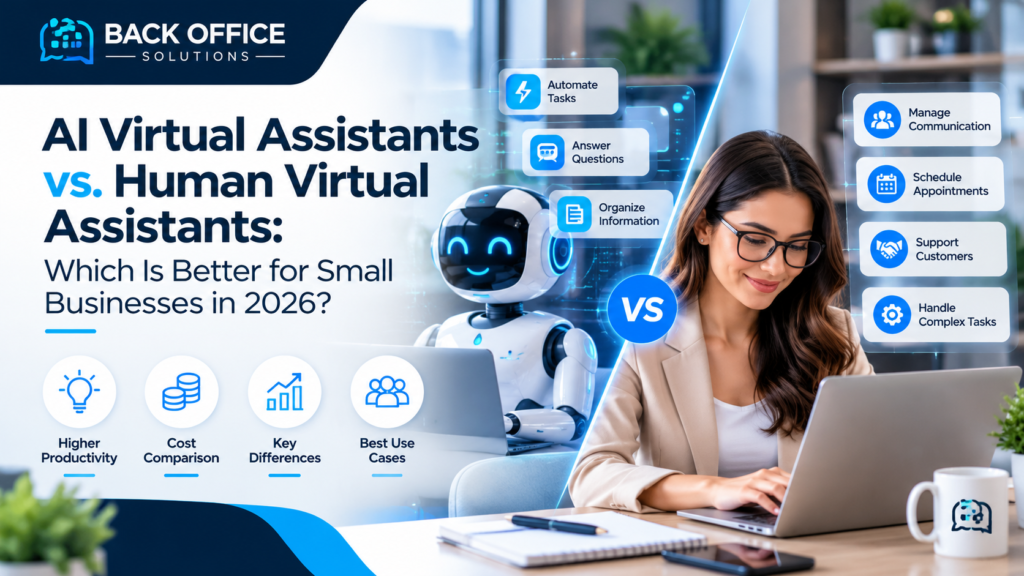
An AI virtual assistant is a software-based system that uses artificial intelligence to perform tasks, process information, answer questions, or support workflows.
Depending on its capabilities and integrations, an AI assistant may help with:
- Drafting routine emails and messages
- Summarizing documents and meetings
- Organizing information
- Responding to common customer questions
- Generating initial content drafts
- Scheduling and workflow automation
- Preparing reports from connected business data
AI-powered assistants can be useful for repetitive, clearly defined activities.
For example, an online store might use an AI chatbot to answer common questions about business hours, shipping policies, and return procedures.
However, an AI assistant’s accuracy and reliability depend on its design, available information, permissions, and supervision.
It may misunderstand customer requests, produce incorrect information, or struggle with unusual situations.
That’s why businesses should consider oversight, particularly when AI systems interact with customers or access sensitive business information.
What Is a Human Virtual Assistant?
A human virtual assistant is a real professional who provides business support remotely.
Unlike an AI software tool, a human virtual assistant can assess situations, communicate directly with people, interpret instructions, and coordinate activities across business functions.
Depending on their experience and responsibilities, human virtual assistants may support:
- Email and calendar management
- Customer communication
- Appointment scheduling
- CRM management
- Lead follow-ups
- Research and administrative tasks
- Document preparation
- Business operations coordination
- Project tracking
- Routine reporting
For example, a real estate agent may need assistance handling inquiries, scheduling property viewings, organizing customer information, and following up with prospective buyers.
A human virtual assistant can coordinate these activities, handle exceptions, and communicate with the agent when decisions are required.
This can help business owners spend more time on their highest-priority responsibilities.
AI Virtual Assistant vs. Human Virtual Assistant: Key Differences
Both approaches can provide value, but their strengths are different.
| Feature | AI Virtual Assistant | Human Virtual Assistant |
|---|---|---|
| Availability | Can operate continuously when systems are available | Works during agreed hours |
| Repetitive tasks | Well suited to defined automated workflows | Can manage repetitive and changing tasks |
| Human communication | Can generate responses but may lack context | Can use judgment, empathy, and relationship awareness |
| Decision-making | Depends on predefined rules, context, and oversight | Can interpret situations and escalate important decisions |
| Cost structure | Software subscriptions, usage, and setup expenses | Hourly, part-time, or dedicated service arrangements |
| Flexibility | Depends on capabilities and integrations | Can adapt to changing business responsibilities |
| Business relationships | Limited by system design | Can maintain ongoing personal communication |
| Supervision | Requires monitoring and quality controls | Requires onboarding, clear instructions, and performance management |
Neither solution is automatically better for every business.
The important question is which responsibilities should be automated and which require human support.
5 Tasks AI Virtual Assistants Can Help Automate
1. Routine Email Drafting
AI tools can prepare replies to common inquiries and help organize written communications.
However, customer-sensitive or high-stakes emails should be reviewed before sending.
2. Meeting Summaries
AI meeting assistants can summarize discussions and identify possible action items when properly configured and used with appropriate participant permissions.
A team member should verify important details before acting on those summaries.
3. Frequently Asked Questions
AI chatbots can answer repetitive questions using approved business information.
For example, an ecommerce business may automate basic shipping or return-policy inquiries while referring complicated issues to a support representative.
4. Data Organization
AI can assist with categorizing information, extracting fields, and formatting routine records.
Businesses should verify accuracy before updating financial, customer, or operational systems.
5. Initial Content Preparation
AI can help generate outlines, brainstorm ideas, and prepare early drafts.
Human review remains important for factual accuracy, brand voice, original insights, and final publication quality.
5 Business Tasks Better Suited to Human Virtual Assistants
1. Personalized Customer Communication
Customers don’t always have simple questions.
Some situations involve frustration, confusion, changing requirements, or sensitive information.
Human assistants can evaluate the situation, communicate appropriately, and escalate issues when necessary.
2. Complex Appointment Coordination
Automated scheduling systems work well when appointment rules are straightforward.
However, coordinating several participants, adjusting urgent meetings, handling special requests, and resolving scheduling conflicts may require human judgment.
3. Lead Follow-Up and Relationship Management
Lead generation isn’t just about collecting contact information.
Businesses also need consistent follow-ups, accurate CRM records, appropriate communication, and coordination between sales activities.
A trained human virtual assistant can manage these activities while following the company’s procedures.
4. Administrative Problem-Solving
Business instructions are not always predictable.
A client may request a last-minute change, an appointment may need rescheduling, or important information may be missing.
Human assistants can investigate these situations and communicate possible solutions.
5. Coordinating Multiple Business Responsibilities
Many small business owners need more than help with one task.
They need someone who understands daily priorities and keeps different activities organized.
A human virtual assistant can support coordination across communication, scheduling, records, follow-ups, and administrative workflows.
For businesses dealing with unpredictable workloads, this flexibility may be especially valuable.
Can AI and Human Virtual Assistants Work Together?
Yes. In many cases, combining AI tools with human virtual assistants can be more practical than choosing only one.
A hybrid approach uses automation for suitable repetitive activities while keeping a person responsible for tasks requiring judgment and oversight.
Practical Example: A Small U.S. Real Estate Business
Imagine a real estate agency receiving inquiries through its website.
Here’s how a hybrid workflow could operate:
Step 1: Initial Inquiry
An approved automated system records a new inquiry and acknowledges receipt.
Step 2: Information Organization
The inquiry details are added to the agency’s CRM system through an authorized integration.
Step 3: Human Review
A virtual assistant reviews the inquiry, checks relevant details, and identifies any missing information.
Step 4: Appointment Coordination
The assistant communicates with the prospective customer and coordinates the viewing schedule.
Step 5: Follow-Up
The assistant updates CRM records, sends appropriate reminders, and alerts the real estate agent when personal attention is required.
This example illustrates how businesses can combine automation and human oversight.
It is a hypothetical workflow, not a claim about a particular customer or completed Back Office Solutions project.
AI vs. Human Virtual Assistant: Which Is More Cost-Effective?
Cost is one of the biggest considerations when choosing business support.
AI tools may have relatively low entry-level subscription costs, but the total expense can also include implementation, integrations, maintenance, usage fees, and human supervision.
Human virtual assistants generally involve ongoing service costs based on working hours, responsibilities, expertise, and the support arrangement.
Rather than comparing monthly prices alone, businesses should evaluate the overall cost of completing work accurately and consistently.
Consider these questions:
- How much time does each solution save?
- How often does the work require human intervention?
- What happens when an unusual situation occurs?
- What is the potential cost of errors?
- How important is personalized customer communication?
- Does the solution reduce the owner’s management workload?
For example, an AI tool may efficiently organize routine meeting notes, while a human assistant may be better suited to coordinating client communications and managing changing priorities.
The lowest-priced option is not necessarily the best value.
When Should You Choose an AI Virtual Assistant?
AI assistance may be appropriate when your business has:
- Repetitive and clearly defined tasks
- High volumes of routine information
- Standardized workflows
- Reliable approved data sources
- Suitable quality-control procedures
- Limited need for personal interaction
For example, a business that frequently receives the same basic customer questions might benefit from an automated FAQ assistant.
However, the system should have an escalation process when a question falls outside its capabilities.
When Should You Hire a Human Virtual Assistant?
Human virtual assistance may be a better fit when your business needs:
- Ongoing administrative coordination
- Personalized customer communication
- Executive or calendar management
- Lead follow-ups
- CRM updates requiring judgment
- Support across multiple business processes
- Adaptability as priorities change
A human VA can be especially useful when the business owner wants to delegate responsibilities rather than manage several separate automation systems.
For U.S. companies, it’s also worth checking the assistant’s availability, time-zone overlap, communication procedures, and experience with relevant business tools.
How Small Businesses Can Choose the Right Solution
Before investing in AI tools or hiring a virtual assistant, follow these practical steps.
Step 1: List Your Recurring Tasks
Identify the activities taking up the most time every week.
Separate repetitive work from tasks involving judgment, customer relationships, or complex decisions.
Step 2: Evaluate Complexity
Ask whether each task follows predictable rules or frequently involves exceptions.
Highly predictable tasks may be suitable for automation.
Tasks with changing instructions may benefit from human support.
Step 3: Consider Data Security
Identify what customer, employee, and company information the solution will access.
Review confidentiality requirements, access permissions, retention practices, and any relevant legal or industry obligations.
Step 4: Calculate the Full Cost
Compare subscriptions, setup time, training, supervision, staffing, and possible error-related expenses.
Step 5: Start With a Defined Workflow
Test one manageable process before expanding.
For example, begin with meeting scheduling or CRM record maintenance.
Step 6: Measure Business Outcomes
Track whether the arrangement improves turnaround time, work quality, customer experience, and the owner’s available time.
These measures matter more than simply counting automated tasks.
Why Human Virtual Assistants Still Matter in 2026
AI can support many business processes, but operating a company involves more than processing information.
Customers expect clear communication. Teams need coordination. Business owners need dependable assistance when circumstances change.
Human virtual assistants can contribute professional judgment, contextual understanding, and ongoing responsibility for agreed tasks.
At the same time, capable human assistants can use approved productivity tools, including AI, where doing so is appropriate and permitted.
For many businesses, the goal shouldn’t be choosing humans against AI.
It should be designing a reliable workflow in which technology supports people and people remain accountable for important decisions.
Frequently Asked Questions
1. Will AI replace human virtual assistants?
AI may automate portions of administrative work, but not every task is suitable for automation. Responsibilities involving complex communication, judgment, changing priorities, and relationship management can continue to benefit from human support.
2. Is an AI virtual assistant cheaper than a human virtual assistant?
Some AI tools have lower initial subscription costs. However, implementation, integration, oversight, usage fees, and errors can affect total cost. Human VA pricing also depends on the level and scope of service. Compare complete workflows rather than subscription prices alone.
3. Can AI virtual assistants handle customer support?
Yes, AI assistants can help with routine customer inquiries when connected to approved information and properly monitored. Complicated or sensitive situations may require escalation to a human representative.
4. What can a human virtual assistant do for a small business?
A human virtual assistant may assist with scheduling, email management, lead follow-ups, CRM updates, customer communication, research, and general administrative coordination, depending on the agreed service scope.
5. Can small businesses use AI and human virtual assistants together?
Yes. A hybrid workflow can use AI for suitable repetitive activities while assigning human assistants to review information, manage exceptions, communicate with customers, and coordinate responsibilities.
6. How do I choose a virtual assistant service?
Start by identifying your business needs. Then evaluate the provider’s relevant experience, task coverage, communication procedures, availability, onboarding process, confidentiality practices, and service agreement.
Final Thoughts: The Right Virtual Assistant Depends on Your Business
Choosing between an AI virtual assistant and a human virtual assistant isn’t about finding a universal winner.
AI tools can help automate routine tasks and improve efficiency when implemented carefully.
Human virtual assistants can provide personalized communication, business coordination, and adaptable support for responsibilities that require more than automation.
For many U.S. small businesses, a thoughtful combination of technology and human expertise may provide the most practical solution.
The right approach is the one that helps your business operate more smoothly without compromising accuracy, customer experience, or accountability.
Get Virtual Assistant Support From Back Office Solutions
Managing a growing business can become challenging when administrative work, customer communication, scheduling, and everyday responsibilities compete for your attention.
Back Office Solutions offers virtual assistant services and specialized business support to help companies manage their workloads more effectively.
Whether you need ongoing assistance across daily activities or support with a particular business function, our team can discuss an arrangement based on your requirements.
Explore Back Office Solutions and contact our team to discuss your virtual assistant needs.